
30,000+ px
Dedicated Production Facility
5 Lines
Automated Structural Fabrication
10+ Years
Global Agricultural Engineering
ISO 9001
Certified Quality Management
DUE DILIGENCE FRAMEWORK
Mitigating Risk in Commercial Agritech Investments
Scaling controlled environment agriculture requires substantial capital outlay. When executing institutional or commercial greenhouse infrastructure projects, procurement errors can result in disastrous yield loss, structural failure, or costly operational bottlenecks. Identifying whether an overseas supplier is a true engineering-backed manufacturing plant or merely an intermediary trading broker is paramount to project survival.
This technical verification guide establishes an objective standard across five structural pillars: direct facility auditing, material engineering specifications, standardized quality management, micro-climate customization integrity, and comprehensive turnkey execution. You can cross-reference our core manufacturing criteria directly via our Quality System Auditing Overview (Section 3) or review actionable technical responses in the Greenhouse Verification FAQ below.

BENCHMARK 01
Direct Manufacturer vs. Trading Broker: The Verification Protocol
Do not rely on digital storefronts alone. Validate the supplier’s hard assets, production pipelines, and independent structural patents.

The 5 Essential Physical Verification Checkpoints
A bona fide commercial greenhouse enterprise operates heavy machinery, maintains continuous factory throughput, and assumes direct legal liability for steel integrity and dimensional accuracy. Commercial buyers must verify:
- Automated Production Lines: Continuous steel tube forming, precision punching, and robotic milling capabilities.
- Proprietary Patents: Patented profile connecters, condensation gutter drainage, and light-deprivation mechanics.
- Rigid In-House QC Protocols: Spectrometer analysis of zinc coatings, tensile steel pull-tests, and bolt shear assays.
- Dedicated Engineering Teams: In-house structural calculation engineers instead of outsourced freelance draftsmen.
- Verifiable Export Bill of Ladings: Demonstrated history of customs clearance and multi-container project deliveries worldwide.
| Verification Variable | Commercial Manufacturing Plant (Panda Standard) | Third-Party Trading Intermediary |
|---|---|---|
| Production Infrastructure | Owns 30,000 square meter factory floor, running 5 dedicated specialized extrusion lines. | Operates virtual office; brokers orders through fragmented subcontractors. |
| Engineering Customization | Direct engineering adjustments for local snow/wind building codes and HVAC integration. | Fixed catalogue configurations; unable to calculate local dynamic structural loads. |
| Traceability & Accountability | Single-source material batch logging, hot-dip zinc certifications, and mill test tracking. | Scattered supplier sourcing without end-to-end component traceability. |
| Lead Times & Escalation | Immediate production line scheduling and rapid replacement component fabrication. | Extended lead times caused by third-party broker renegotiation layers. |
BENCHMARK 02
Structural Durability & Material Engineering Integrity
Evaluate structural steel treatment metrics, structural load tolerance computations, and cladding UV degradation resilience.
Zn
Hot-Dip Galvanized Framework
Structural reliability starts with corrosion resistance. Industrial greenhouse structures must utilize high-tensile steel hot-dip galvanized inside and out (zinc coating ≥ 275g/m² up to 450g/m² conforming to EN ISO 1461 standards) to survive high-humidity horticultural micro-climates for over 20 years.
W/S
Wind & Snow Load Computations
Never accept generic spec sheets. Legitimate manufacturers run finite element analysis (FEA) to confirm gutter, truss, and post load resistances match your site-specific wind velocity (up to 140+ km/h) and snow load demands (exceeding 0.5 kN/m²) according to structural standards.
UV
Glazing Integrity & Warranties
Whether configuring multi-wall Polycarbonate, diffuse Horticultural Float Glass, or multi-layer PO film, verify co-extruded UV protection layers, anti-drip internal surfaces, and long-term PAR light transmittance warranties (backed by 10-year manufacturer guarantees).
BENCHMARK 03
ISO 9001 Quality System Verification: End-to-End Control
A genuine ISO 9001 certification governs the entire manufacturing lifecycle, not just clerical administration.
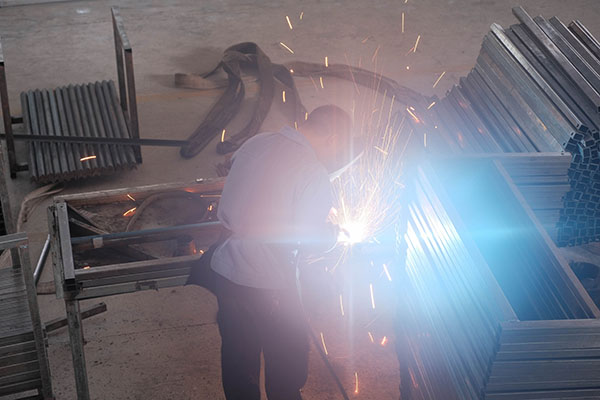
Procuring from an ISO 9001-certified factory ensures that your project doesn't suffer from batch-to-batch variability. At Panda Greenhouse, the quality management system permeates four distinct manufacturing phases. When auditing an overseas partner, verify these explicit system workflows:
1. Incoming Raw Material Inspection (IQC):
Steel coil gauge testing, chemical composition analysis, and zinc coating thickness verification before entering processing lines.
2. In-Process Quality Audits (IPQC):
Automated tolerance tracking during cold roll-forming, laser cutting, robotic welding joints, and hole-alignment drilling.
3. Final Product Pre-Dispatch QA (FQC):
Pre-assembly fitment testing, truss defection trials, and systematic component counting against project packing lists.
4. Closed-Loop Corrective Action Procedures (CAPA):
Formally documented engineering issue tracking to eliminate recurring structural defects and supply errors.



BENCHMARK 04
Custom Engineering Validation: Spans, Ventilation, Thermal & Blackout
Industrial commercial scale demands tailored engineering, not rigid off-the-shelf catalog units.
📐
Structural Spans
Verify customized span widths (8m, 9.6m, 12m, 16m) and post heights up to 8m tailored to crop canopy volume and suspended equipment loads.
💨
Ventilation Design
Continuous roof ridge vents, rack-and-pinion actuators, insect exclusion screens, and evaporative pad airflow dynamic balancing.
🌡️
Thermal Efficiency
Motorized internal heat-retention screens, perimeter wall insulation, and double-wall air inflation controls for minimal BTU waste.
🌑
100% Light Deprivation
Engineered automated breathers, light-trap exhaust hoods, and triple-layer 99.9% blackout curtains for photoperiod-sensitive crops.
BENCHMARK 05
Selling a Product vs. Delivering a Project: Turnkey Field Support
A shipping container of steel is not a functioning commercial greenhouse. True manufacturers secure your installation success.

Comprehensive Engineering Blueprints
Every component is pre-cut, pre-punched, and systematically tagged to match 3D isometric structural construction drawings, foundation anchor layout schemes, and electrical integration schematics.

Harmonized Subsystem Integration
Direct supply and synchronization of internal microclimate machinery: automated fertigation arrays, climate automation computers, supplemental LED luminaires, and benching systems.

On-Site & Remote Field Engineering
Continuous installation oversight: assign technical project supervisors directly to your site or leverage real-time remote telemetry engineering support to eliminate contractor assembly errors.
Why Panda Greenhouse Sets the Industry Standard
Panda Greenhouse operates a modern 30,000 square meter factory floor equipped with 5 specialized automated roll-forming and structural lines. With over 10 years of worldwide export experience, we do not simply broker standard metal parts—we engineer, fabricate, and deliver integrated horticultural environments. Discover our team, corporate history, and technical philosophy on our About Us page.
Ready to submit your structural load criteria, crop blueprints, and local climatic conditions for technical and commercial evaluation? Request direct factory pricing via our formal Request a Quote (RFQ) gateway.
Initiate Project Engineering ConsultationPRODUCT PORTFOLIO
Engineered Commercial Greenhouse Systems & Accessories
Explore our industrial range of precision-manufactured horticultural facilities and complete cultivation solutions.


FAQ VERIFICATION PROTOCOL
Commercial Greenhouse Manufacturer Verification FAQ
Essential due diligence inquiries to confirm technical capability, material standards, and execution readiness.
Q1: How can I physically verify if a supplier is a real factory or a trading company?
Request a continuous, unedited video walk-through showing the company sign, continuous production line machinery, and finished inventory warehouse. Check the business license scope ("Manufacturing" vs. "Wholesale/Consulting") and audit the physical ownership of their stamping, rolling, and cutting apparatus. As detailed in our Quality System Auditing Guide (Section 3), an authentic plant maintains continuous ISO 9001 quality logs for raw steel arrivals.
Q2: What zinc coating thickness is needed for a commercial greenhouse?
For commercial setups subject to constant relative humidity exceeding 70-80%, electro-galvanized (cold-plated) pipe is insufficient and will corrode within 2-3 years. You must mandate standard hot-dip galvanized steel featuring a minimum zinc mass of 275g/m² up to 450g/m² (conforming to EN ISO 1461 / ASTM A123). Ask for metallurgical mill test reports with every order.
Q3: Can Panda Greenhouse engineer structures to match regional building codes?
Yes. Commercial structures must conform to localized wind speed and ground snow load records. Our engineering group utilizes FEA software to model column spacing, roof truss geometry, and gutter dimensions to withstand regional climatic loads (up to 140+ km/h wind velocity and 0.5+ kN/m² snow load). Review our custom capabilities above or send specific location parameters directly to our engineering desk via our Contact Us and RFQ page.
Q4: What installation support does Panda Greenhouse provide internationally?
We eliminate the gap between component delivery and operational commissioning. Every commercial build receives matched isometric construction drawings with serialized part numbering. We provide direct on-site supervisor dispatch, full-schedule virtual engineering consults, and step-by-step assembly schematics to ensure your regional labor crew completes construction efficiently.